Newborn Resuscitation
The Right Response at the First Breath, a Safe Future.
NOVOS Resuscitation Solutions provide controlled and safe breathing for newborns during their most critical moments.
The neonatal resuscitation process is a clinical procedure performed in the delivery room or the neonatal intensive care unit (NICU) where every second counts and there is no room for error. The configuration of the devices used in this process not only makes the physician’s job easier but also directly determines the baby’s neurological and pulmonary future.
Critical Components in Neonatal Resuscitation: T-Piece Resuscitation, Blender, and Mobile Flexibility
The integration of the T-Piece Resuscitation Device, Air/Oxygen Mixer (Blender), Flowmeter, and Mobile Stand constitutes the safest “gold standard” combination recommended by international guidelines (NRP, AHA, ERC) for neonatal resuscitation
The NOVOS Easypuff Resuscitation Unit, available with either a radiant heater integration or a mobile stand, provides safe and uninterrupted life support when clinicians need it most.
The Clinical Superiority of T-Segment Revitalization Technology
Traditional self-inflating bag-valve-mask (Ambu) systems create varying pressures in infants depending on the user’s technique and the force applied. Systems with T-pieces, on the other hand, eliminate these user-related risks.
Controlled PIP and PEEP Management: Devices with a T-piece maintain the set Peak Inspiratory Pressure (PIP) and Positive End-Expiratory Pressure (PEEP) at a constant level with each breath. This helps prevent the risk of volutrauma or barotrauma caused by excessive pressure on the baby’s delicate lungs, while also preventing alveolar collapse (atelectasis).
Establishing Functional Residual Capacity (FRC): A constant PEEP is vital for clearing lung fluid after birth and establishing a functional lung volume. T-parça, resüsitasyon boyunca bu basıncı yüksek doğrulukla korur.
The Clinical Significance of Blender (Air/Oxygen Mixer) Configuration
While the use of 100% oxygen in newborn resuscitation was common in the past, current clinical evidence has shown that it has damaging effects on infant cells.
Hyperoxia and Prevention of Hyperoxic Injury: Free oxygen radicals increase rapidly in infants resuscitated with 100% oxygen. This condition can lead to retinopathy of prematurity (ROP), chronic lung disease (BPD), and brain damage.
Precision Titration (FiO2): The blender configuration allows the clinician to set the exact desired concentration of oxygen in the gas mixture, ranging from 21% (room air) to 100%. The guidelines require that resuscitation in full-term infants begin with 21% oxygen and in preterm infants with 21–30% oxygen, and that titration be adjusted via the blender based on target SpO₂ values.
Operational and Clinical Benefits of the Optional Mobile Stand
One of the most important factors in reducing chaos during newborn resuscitation is ergonomics.
Mobility in the Race Against Time: During transfers between the delivery room, the operating room (C-section room), and the intensive care unit, the device—mounted on a mobile stand and integrated with a mixer and flowmeter—can be moved as a single unit, minimizing the time required for emergency intervention.
Ergonomic and Integrated Workspace: During resuscitation, the physician’s attention must be focused on both the infant and the monitor. The mobile stand prevents distractions by keeping all control buttons, pressure gauges, and gas connections within the physician’s reach.
Proper First Aid at the First Sign

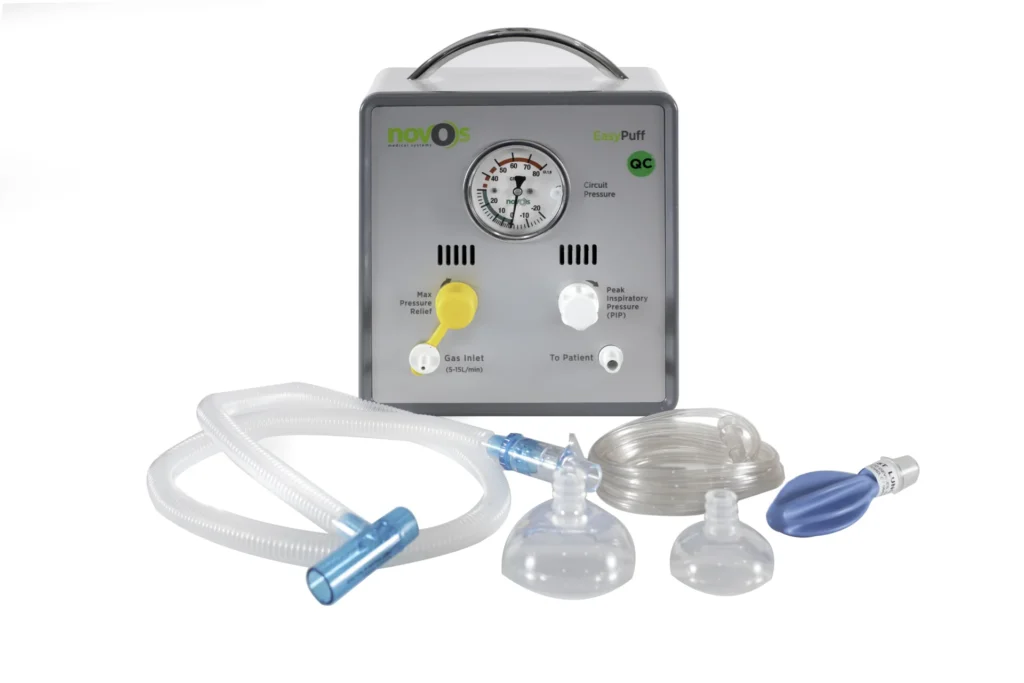
T-Piece Resuscitator
Easypuff is an excellent option for the proper and controlled resuscitation of newborns in emergency departments, delivery rooms, transport vehicles, and neonatal intensive care units (NICUs).